If guests say your restaurant is “too loud,” it can hurt your business fast. People do not relax. They talk less. They leave sooner. And they remember the noise more than the food.
The frustrating part is this. You can spend a lot on design, lighting, and furniture, and still lose comfort because of one thing: echo.
This guide explains why restaurants get loud, what an acoustic ceiling actually does, and how to choose a solution that fits Thailand’s climate and restaurant workflow. You will also learn how to talk to contractors in a smarter way, so you do not pay for the wrong thing.
If you want to see what an acoustic stretch ceiling looks like in real projects, you can start with Beetlewings’ acoustic ceiling page and come back to this guide as you read. Acoustic ceilings by Beetlewings
When “lively” becomes “too loud”
Restaurants should have energy. Nobody wants a room that feels like a library.
But there is a tipping point. Past that point, guests stop enjoying the meal. Conversation feels like work. People start leaning in and repeating themselves. Then the room gets louder again.
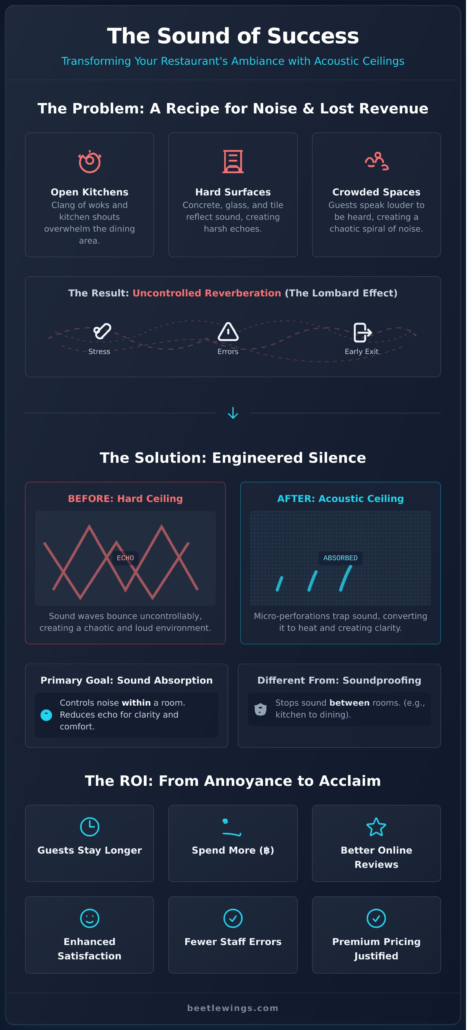
Acoustics experts have studied this for years because it happens in the same way across countries and restaurant styles. A well known overview from the European Acoustics Association explains that restaurant noise is a feedback situation. People talk, the room reflects sound, and the rising noise makes people raise their voice even more. That loop is part of the Lombard effect. Restaurant acoustics guide (European Acoustics Association)
Here is the simple takeaway. You do not “fix noise” by telling staff to lower the music. If the room is reflective, the noise will always climb during peak hours.
Why Thai restaurants get noisy so easily
Thailand has its own set of design trends and practical needs. Many of them push sound in the wrong direction.
Bangkok restaurants often use hard, clean finishes. Tile is popular because it is easy to mop. Glass is popular because it looks modern and makes the space feel bigger. Polished concrete is popular because it feels premium and minimal.
Those choices can look great. But sound bounces off them like a ball.
In Phuket and other coastal areas, owners also avoid soft materials because humidity can bring smells and stains. So the room becomes even harder.
Then you add an open kitchen, a bar, and a busy dinner rush. That is how you get the classic review: “Amazing food, but we could not talk.”
What is really happening in the room
Sound moves in waves. When those waves hit a hard surface, they reflect back into the space. When reflections happen again and again, you get reverberation. People often call it echo, even if it is not a clear echo like a tunnel.
Reverberation makes speech less clear. It smears words together. Guests then push their voice louder so they can be understood.
This is why a restaurant can feel loud even when the music is not loud. The room itself is adding to the noise.
The World Health Organization has a clear point on speech comfort. It notes that longer reverberation times make speech perception more difficult and more straining. It also explains that people raise their voice as interfering noise rises, which adds strain for both speaker and listener. WHO Guidelines for Community Noise (PDF)
You do not need to measure reverberation time to understand this. You can feel it the moment you step into the room.
Absorption vs soundproofing (most restaurants mix this up)
Owners often say they want “soundproofing.” But what they really want is less echo.
Sound absorption reduces noise inside the same room. It reduces echo and improves speech clarity. This is what makes dining feel calmer.
Soundproofing stops sound from traveling between spaces. It helps if kitchen noise leaks into the dining room. It also helps if neighbors complain about bass. But it is a different kind of build detail. It often needs heavier layers and sealed gaps.
If your main issue is “we cannot talk at the table,” you usually want absorption first.
The one number you will see on brochures: NRC
NRC stands for Noise Reduction Coefficient. It is a single number that helps you compare how much sound a material absorbs in key frequencies.
Think of it like this. A hard ceiling reflects most sound. An acoustic material absorbs more sound. NRC is one way to show that difference.
It is based on lab testing. Intertek describes NRC as the average of sound absorption coefficients at 250, 500, 1000, and 2000 Hz, rounded to the nearest 0.05. ASTM C423 overview and NRC definition (Intertek)
NRC is not the whole story, but it is a good place to start. Especially when the ceiling is your biggest reflective surface.
A quick diagnosis you can do before calling anyone
You can learn a lot by doing a simple walk-through.
Stand in the center of the dining room when it is empty. Clap once. If you hear a ring that hangs around, you have strong reflections.
Then look up. If the ceiling is concrete, gypsum, wood, or metal, it is likely reflective. If your walls are mostly glass, tile, and bare plaster, you have the same problem on the sides.
Now picture the dinner rush. Every voice is now bouncing around. That is why the problem shows up at night and not at 3 pm.
One more check. Notice if the loudest area is near the bar or the open kitchen. If yes, you may need higher absorption in those zones, not only “general coverage.”
So what is an acoustic ceiling, really?
An acoustic ceiling is not just a “ceiling finish.” It is a sound control surface.
It reduces reverberation by absorbing sound energy instead of reflecting it back into the room. When you reduce reverberation, speech becomes clearer. Guests do not need to raise their voice as much. The room stays calmer during service.
This is why acoustic ceilings are popular in hospitality. The ceiling is often the largest uninterrupted surface in the restaurant. Treating it can change the feel of the whole room without moving tables or changing the kitchen layout.
Types of acoustic ceilings used in restaurants in Thailand
There is no single “best” ceiling for every restaurant. The right answer depends on your design, your cleaning needs, and how much downtime you can accept.
Traditional grid ceilings with acoustic tiles
This is the familiar system with tiles and a visible grid. It can work well for absorption. It can also be cost-friendly.
But many restaurant owners do not like the look. The grid can feel like an office. And in food spaces, some tile types can stain or look tired over time, especially near kitchens and bars.
It also limits design freedom. If you want clean lines and integrated lighting, the grid can become a compromise.
Hanging baffles and clouds
These are suspended panels that hang from the ceiling. They are common in modern spaces with high ceilings because they catch sound without covering everything.
They can look great in industrial-style restaurants. They can also be very effective in noisy zones, like above a bar.
The trade-off is cleaning and style. They can collect dust. And they make a strong visual statement that may not match a more minimal or classic Thai dining concept.
Acoustic stretch ceilings
This is where many premium restaurants land, especially when they want a clean ceiling finish.
An acoustic stretch ceiling uses a stretched membrane installed on a perimeter track. When paired with an acoustic layer behind it, it can reduce echo while keeping the ceiling smooth and modern.
Many systems use micro-perforations. These are tiny holes that are hard to see from normal viewing distance. The holes let sound pass through to an absorptive layer behind the membrane. The result is better acoustic control without the “panel ceiling” look.
In Thailand, this type of solution also appeals for practical reasons. Many stretch ceiling finishes are easy to wipe clean. They also handle humidity better than many traditional ceiling finishes when installed correctly.
If you want to understand the design and lighting side, this page shows how the ceiling can stay clean while integrating lightboxes, LED, or feature lighting. Stretch ceiling design and lighting
What good restaurant acoustics feels like (in real life)
Here is the best way to measure success. You should be able to talk at a normal voice level.
You should not need to lean in to hear the person across the table. You should not feel tired after 45 minutes because you spent the whole time fighting noise.
The European Acoustics Association guide puts it in a very human way. It notes that in loud restaurants, conversation can become difficult, and visitors may leave with exhaustion or headache. That is not a design problem. That is a customer experience problem. Restaurant acoustics guide (European Acoustics Association)
How acoustics affects reviews and spending
Noise rarely shows up in the first five minutes. It shows up after the restaurant fills up.
That is why you can have great photos on Instagram and still lose repeat business. First-time guests come for the look. Repeat guests come for comfort.
Also, noise is one of the easiest things for guests to complain about online. People do not always know why the room feels stressful, but they know they did not enjoy talking.
When you fix acoustics, the reviews often shift. Not because people talk about “NRC” or “reverberation time.” They say things like “Nice atmosphere” and “Great place to catch up.”
Planning your ceiling the smart way
Many owners try to fix acoustics after the interior is finished. That is when problems start.
If you add acoustic panels later, they can look like a patch. They may not match the design. They may block lighting. They may take up wall space you need for branding.
A better approach is to plan acoustics with the ceiling design from the start. This is where ceiling-based solutions are useful. The ceiling is already part of the design, so you can make it work for sound at the same time.
When you plan early, you also plan services early. Lighting, speakers, vents, sprinklers, and access hatches can be placed cleanly. This matters more in restaurants than in homes, because you have more systems above the ceiling.
Installation in a restaurant (how to reduce downtime)
Restaurant owners in Thailand usually have one fear. Closing time.
The good news is that many ceiling installs can be planned around off-days, morning hours, or overnight work. It depends on your concept and how complex your lighting is.
Stretch ceiling systems are often chosen because they can be installed without the heavy dust and repainting that comes with plaster work. Beetlewings notes that many rooms can be completed in 1 to 2 days, with minimal disruption, depending on the space and design.
That is not a promise for every restaurant. But it gives you a realistic planning range to discuss with your contractor.
Here is a simple way to think about the flow. First comes measurement and layout planning. Then the perimeter track is installed. Then the membrane is installed and detailed. Fixtures are finished last. If a team tries to “figure out lights on site,” it usually slows everything down.
Maintenance in Thailand’s climate
Thailand is humid. Kitchens produce steam and grease. Air conditioning causes condensation in some spaces. These are real issues for ceilings.
This is why maintenance matters as much as design. A ceiling that stains or cracks will hurt the look of your restaurant, even if your food is great.
Beetlewings describes its ceiling systems as low-maintenance, and it gives clear cleaning guidance. It recommends a soft microfibre cloth, warm water, and mild soap, and it warns against harsh chemicals and abrasives.
The simple rule is this. Choose a ceiling finish you can clean safely, and make sure your team knows how to clean it without damaging it.
Choosing the right solution for your concept
Not every restaurant needs the same ceiling.
If your concept is fast casual, you might accept a visible grid if it saves cost and gives strong absorption.
If your concept is premium dining, the ceiling is part of the brand. In that case, the best solution is often the one that controls sound while keeping the ceiling clean and intentional.
If your restaurant has a lot of glass and tile, ceiling absorption matters more. If you have high ceilings, you often need more absorption than you expect. If you have an open kitchen, you may want to treat the ceiling area closer to the kitchen line with higher performance.
In other words, the best ceiling is the one that matches your room, not the one that looks best in a catalog.
A short expert quote you can use in your planning
Here is one line that sums up the core issue, from the European Acoustics Association guide:
“In a noisy party, everyone raises the voice to be heard better, which again leads to a higher ambient noise level.”
That is the loop you want to break.
What to ask when you request a quote
If you want a ceiling quote that makes sense, avoid one question: “How much per square metre?”
It is not a wrong question. It is just incomplete. Restaurants vary too much.
Instead, ask for a quick site check and a plan.
Ask how the ceiling will integrate with your lighting and services. Ask what cleaning method is safe. Ask how long the install will take for your room, not an average room.
If the contractor cannot explain the difference between absorption and soundproofing, that is a warning sign. If they do not ask about kitchen noise, ceiling height, and wall finishes, they may be guessing.
Frequently Asked Questions
What is the fastest way to make a restaurant feel less noisy?
In most restaurants, the ceiling is the best place to start. It is usually the largest hard surface in the room. When the ceiling absorbs sound, echo drops and speech becomes clearer. That often reduces the “everyone is shouting” feeling during busy hours.
Do I need soundproofing or sound absorption?
If your problem is guests struggling to talk at the table, you usually need sound absorption. Absorption reduces echo inside the room. Soundproofing is different. It blocks sound moving between rooms, like the kitchen to the dining area, or the restaurant to neighbors.
What does NRC mean, and does it matter for restaurants?
NRC stands for Noise Reduction Coefficient. It is a lab-tested number that helps compare how much sound a material absorbs in common speech frequencies. Intertek explains that NRC is calculated from measurements at 250, 500, 1000, and 2000 Hz under ASTM C423. ASTM C423 and NRC overview (Intertek)
Will an acoustic ceiling make the restaurant silent?
No, and it should not. A good restaurant still feels lively. The goal is to reduce harsh echo so conversation feels easy. Guests should not need to raise their voice just to be heard at the same table.
Can acoustic stretch ceilings work with feature lighting and speakers?
Yes. This is one reason many restaurants choose them. Lighting, speakers, vents, and other ceiling items can be planned into the design so the ceiling stays clean. If you are planning lighting changes, it is smarter to plan the ceiling and lighting together. Stretch ceiling design and lighting
How long does installation take in a restaurant?
It depends on the ceiling size, access, and how complex your lighting plan is. Many restaurant projects are scheduled around off-hours or closing days to reduce disruption. If you want a realistic timeline for your space, the best step is a short site check. Contact Beetlewings
Is a stretch ceiling easy to clean in a restaurant?
Cleaning depends on the finish and your kitchen setup, but many stretch ceiling surfaces are designed to be wiped clean. Beetlewings shares cleaning guidance and maintenance notes on its FAQ and service pages. If you want the safe cleaning method for your finish, check this page or ask during your consultation. Stretch ceiling maintenance and FAQs
Can you install an acoustic ceiling without changing the whole interior?
Often, yes. Many acoustic improvements come from treating the largest reflective surfaces, and the ceiling is usually the biggest one. That means you can improve comfort without moving tables, rebuilding walls, or changing the kitchen layout.
What should I prepare before requesting a quote?
Have your ceiling height, photos of the space, and a quick note about the main complaint. For example, “Guests can’t talk when we’re full,” or “Kitchen noise dominates the dining room.” If you already know your lighting plan, share that too. It helps the contractor give you a realistic timeline and design plan.
A clear next step
If your restaurant has noise complaints, start simple. Fix the room’s echo first. In many restaurants, the ceiling is the best place to start because it affects the whole space and does not steal floor area.
If you want a ceiling solution that also looks clean and modern, consider an acoustic stretch ceiling and plan it together with your lighting.
If you want a fast assessment and a quote built around your layout, you can contact Beetlewings for a site visit and consultation. Contact Beetlewings
Done right, guests will not walk out saying “Nice NRC.”
They will say, “We could actually talk.”