

A plain stretch ceiling covers a surface. A design ceiling becomes the light source, the artwork or the focal point of the room.
There are four things you can build in: a printed graphic across the membrane, backlighting that turns the whole ceiling into a soft light source, fibre optic or LED starry skies, and colour-changing RGB you control from a phone or wall panel. They can be combined, and all of them are decided before installation, not added afterwards.
Any image can be printed across the full width of the membrane, with no visible joins even on a large ceiling.
Branding: logos and brand graphics for retail, showrooms and corporate reception areas. Sky and nature: clouds, forest canopy, water. Common in spas, clinics and windowless rooms where the ceiling is doing the work a window would. Artwork: galleries, studios, restaurants and hotel lobbies. Personal designs: bedrooms, home cinemas and children’s rooms.
High-resolution artwork. A ceiling is printed at full scale, so an image that looks fine on screen may not hold up overhead. We check resolution against the finished size before printing and will tell you if it will not work. Vector files for logos wherever possible, so edges stay sharp at any size.
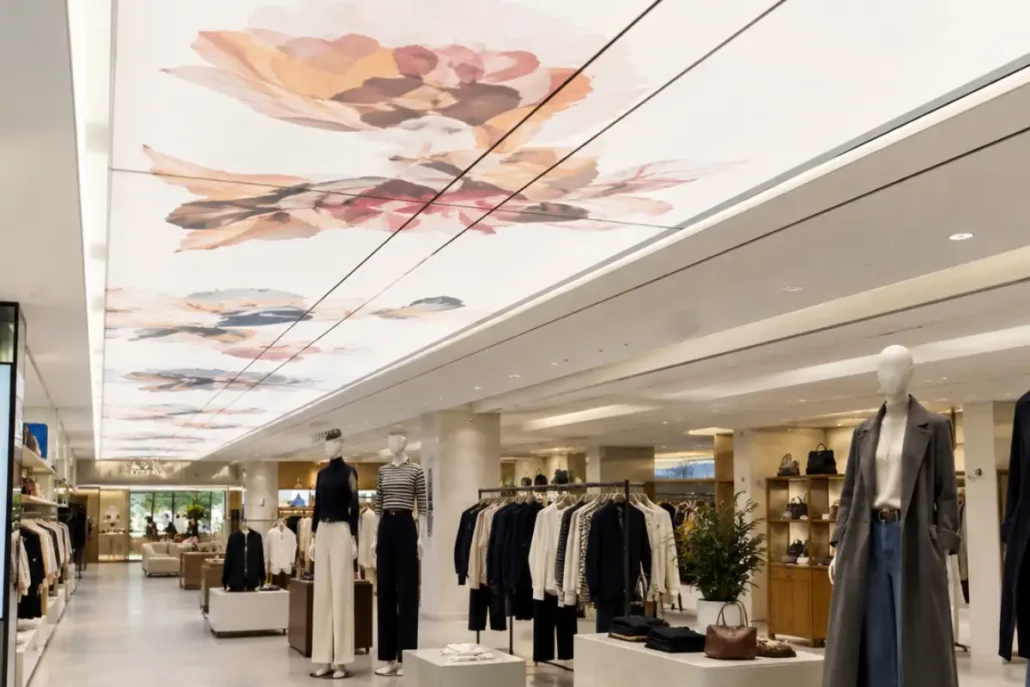
Printed membranes are UV-resistant, so colour holds for years without fading. Printing can be combined with backlighting if the membrane is translucent, which makes the image glow rather than sit flat. Acoustic membranes can also be printed, so a restaurant can cut echo and carry a design at the same time.
A translucent membrane with LEDs behind it turns the entire ceiling into one even light source. No visible fittings, no glare, no hotspots when it is built correctly.

LEDs are mounted in the cavity above the membrane and the light diffuses through it.
Getting an even glow depends on two things: the cavity depth and the LED spacing.
Too shallow, or LEDs spaced too far apart, and you see individual dots through the membrane instead of a smooth surface.
As a rule you need roughly 10 to 15 cm of cavity for a fully backlit panel. We calculate the spacing against the depth available in your room.
This is worth deciding early. It changes the feel of a room more than almost any other choice on this page, and it cannot be changed later without opening the ceiling, unless you specify a tunable or RGB system.
Four systems, each solving a different problem. Most projects use more than one.

Strips hidden in a recess or perimeter cove, throwing light along the ceiling rather than down into the room.
A full backlit panel: a framed cavity of LEDs behind a translucent membrane, producing one even lit surface.
Conventional downlights cut into the membrane during installation.

| Type of Design | Starting Price (Baht/m²) | Features |
|---|---|---|
| Backlit Ceiling | ~ 6,500 THB | Translucent membrane lit from behind, LEDs or lightboxes |
| Starry Sky Effect | ~ 6,500 THB | Fibre optic or LED pinpoints |
| RGB Lighting | ~ 6,500 THB | Colour-changing control from a phone or wall panel |
| Printed Ceiling | ~ 7,500 THB | Custom logos, graphics or themes |
Price is based on 5 sqm and may vary depending on the total project size.

| Feature | Standard Stretch Ceiling | Design & Lighting Ceiling |
|---|---|---|
| Look | Matte or glossy | Printed, backlit, starry, RGB |
| Lighting | Limited | Full LED, spotlights, or lightboxes |
| Customisation | Colour choice only | Complete design freedom |
| Cost | ~ 3,000 THB/m² | ~ 6,500 THB/m² and up |
| Impact | Clean finish | Striking design feature |
Price is based on 5 sqm and may vary depending on the total project size.
Different rooms need different lighting. These are the specifications we most often recommend.
Bedrooms: fibre optic starry sky, or backlit at 2700K on a dimmer.
Living rooms: perimeter cove lighting at 2700K to 3000K, with spots over seating.
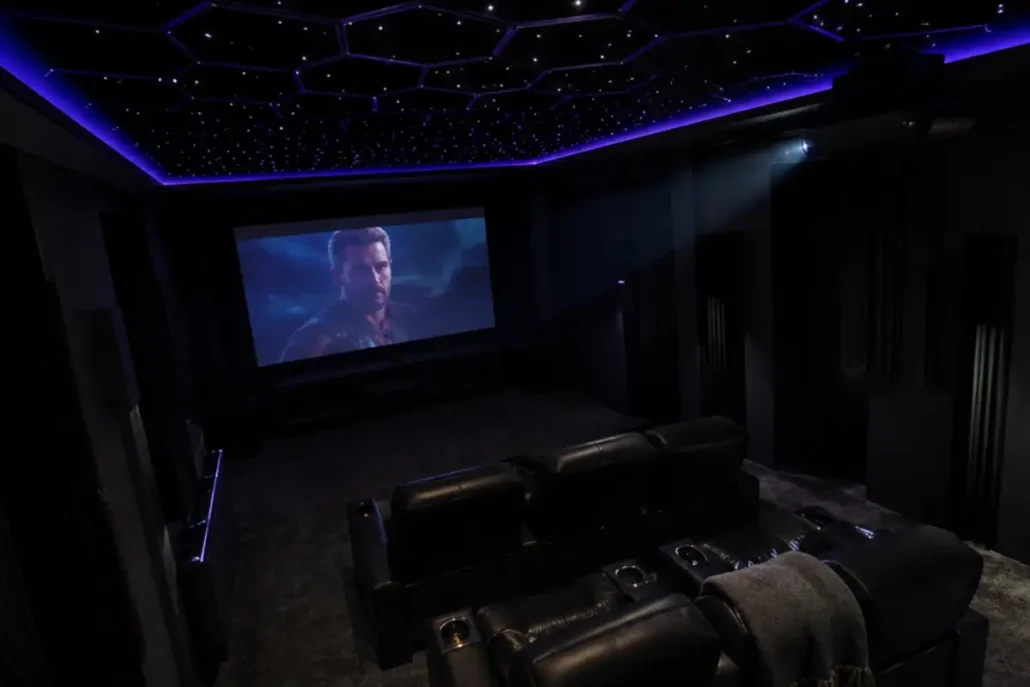
Home cinema: starry sky plus dimmable RGB, so the ceiling drops to near-dark during a film.
Kitchens and bathrooms: gloss finish with recessed spots. Handles humidity and bounces light around a smaller room.
Restaurants: warm backlighting at 2700K, often on an acoustic membrane so the ceiling cuts echo as well as lighting the room.
Bars and clubs: RGBW with scene control, so the room shifts from early evening to late night.
Retail and showrooms: 4000K lightboxes for even, shadow-free light on product, or printed membranes carrying brand graphics.
Hotel lobbies: shaped lightboxes as the architectural feature of the space.
Offices: 4000K backlit panels for glare-free light on screens, often on acoustic membrane in meeting rooms.
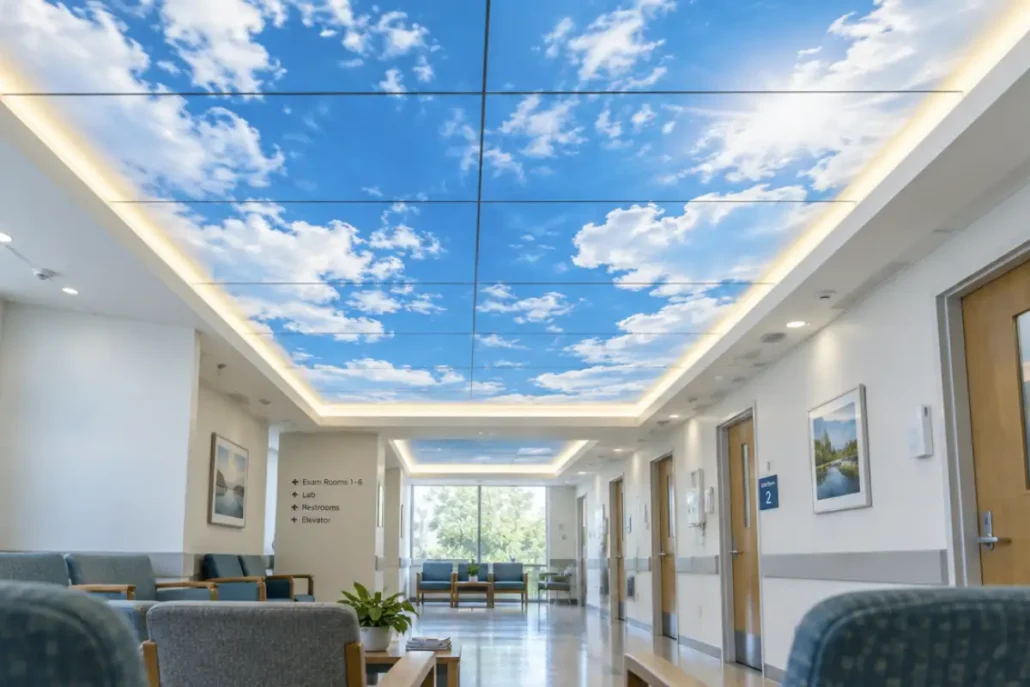
Clinics and treatment rooms: printed sky panels overhead, where patients spend time looking up.
Galleries and museums: even diffused light that does not compete with the exhibits.
Event venues: DMX-controlled RGB for programmable scenes.
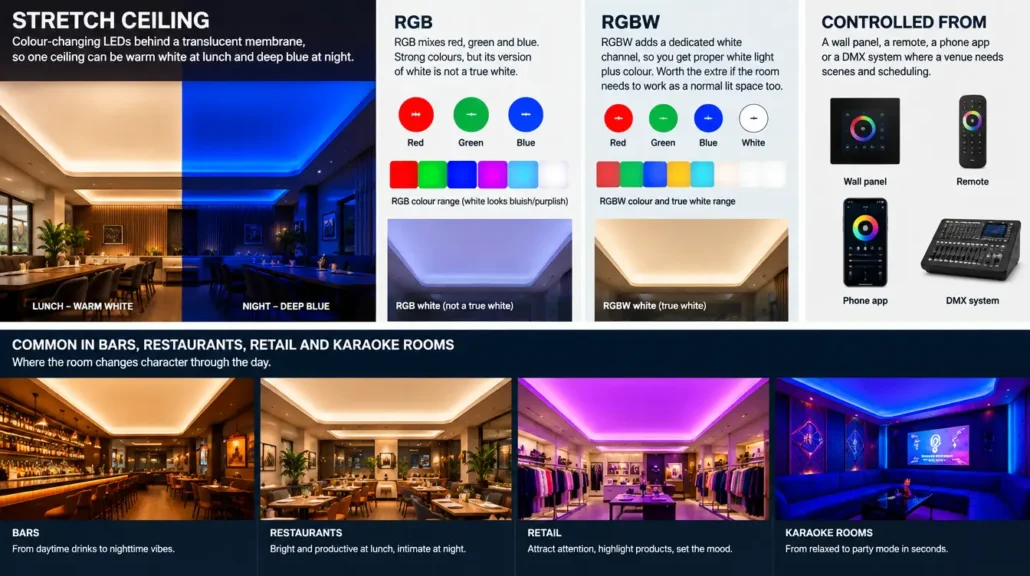
Colour-changing LEDs behind a translucent membrane, so one ceiling can be warm white at lunch and deep blue at night.
RGB mixes red, green and blue. Strong colours, but its version of white is not a true white.
RGBW adds a dedicated white channel, so you get proper white light plus colour. Worth the extra if the room needs to work as a normal lit space too.
Controlled from a wall panel, a remote, a phone app or a DMX system where a venue needs scenes and scheduling.
Common in bars, restaurants, retail and karaoke rooms, where the room changes character through the day.
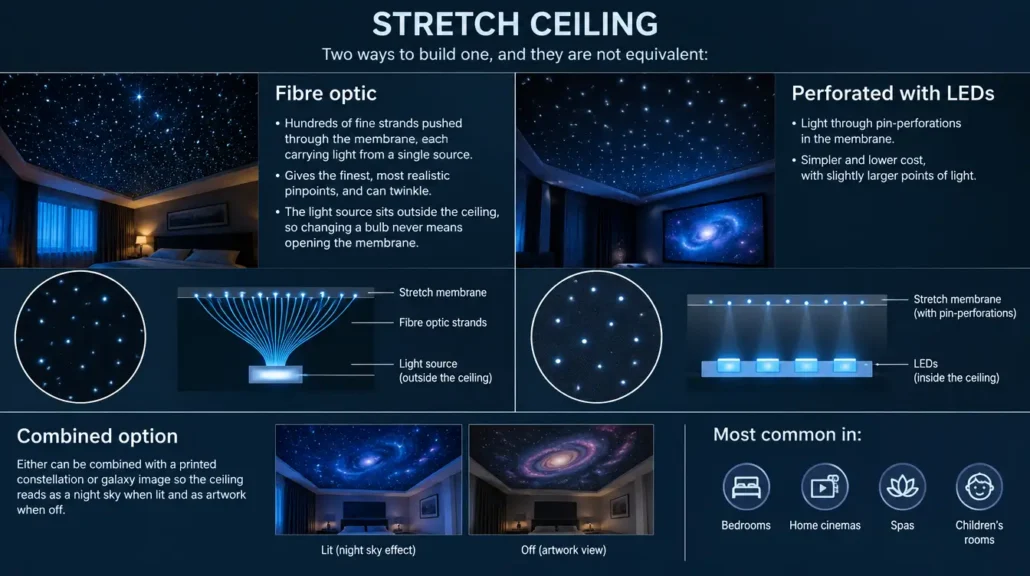
Two ways to build one, and they are not equivalent:
Fibre optic: hundreds of fine strands pushed through the membrane, each carrying light from a single source. Gives the finest, most realistic pinpoints, and can twinkle. The light source sits outside the ceiling, so changing a bulb never means opening the membrane.
Perforated with LEDs: light through pin-perforations in the membrane. Simpler and lower cost, with slightly larger points of light.
Either can be combined with a printed constellation or galaxy image so the ceiling reads as a night sky when lit and as artwork when off. Most common in bedrooms, home cinemas, spas and children’s rooms.

Wipe with a soft cloth and mild soapy water. Printed membranes are UV-resistant and hold colour for years.
The question people actually ask is what happens when an LED fails. The membrane unclips from its track and refits, so the cavity stays reachable without damaging the ceiling. We use LED systems rated for long service life precisely because they sit behind a ceiling, and with fibre optic starry skies the light source is mounted outside the cavity, so it can be serviced without touching the membrane at all.
No obligation. Ask us anything about cavity depths, colour temperatures or lead times.
Roughly 10 to 15 cm of cavity for a fully backlit panel, so light diffuses evenly instead of showing individual LED dots. A plain ceiling with recessed spots needs far less. Tell us your available height and we will confirm what is achievable.
2700K to 3000K warm white for restaurants, bedrooms and living rooms. 4000K neutral for offices and retail. 5000K to 6000K cool white for clinics and showrooms. Worth deciding early, because changing it later means opening the ceiling unless you specify a tunable or RGB system.
RGB mixes red, green and blue, which gives strong colours but not a true white. RGBW adds a dedicated white channel, so the ceiling also works as normal white lighting. If the room needs to function as an ordinary lit space, RGBW is worth the difference.
High-resolution files, and vector artwork for logos wherever possible. A ceiling is printed at full scale, so an image that looks fine on screen may not hold up overhead. We check your artwork against the finished size before printing and will tell you if it will not work.
Fibre optic gives finer, more realistic pinpoints and can twinkle, and its light source sits outside the ceiling so it can be serviced without opening the membrane. LED perforation is simpler and lower cost, with slightly larger points of light.
Yes, and it is common. A restaurant might use a printed acoustic membrane with warm backlighting, so the ceiling cuts echo, carries a design and lights the room. These are planned together, since they compete for the same cavity depth.
The membrane unclips from its track and refits, so the cavity stays accessible without damaging the ceiling. With fibre optic starry skies the light source is mounted outside the cavity and can be serviced without touching the membrane at all.
No. Printed membranes are UV-resistant and hold colour for years, including in rooms with strong natural light.